I spent years believing “Content is King,” only to watch my rankings slide because my site “felt” slow. Google doesn’t just care about what you say anymore; it cares deeply about how your site behaves while you’re saying it. I had to stop being just a writer and start thinking like a technical architect to save my traffic. Here are the 7 hard-won lessons I wish I’d known before I started chasing those elusive green bars in Search Console.
1. Lab Data is a Map, but Field Data is the Territory:
The first mistake I made was obsessing over the score I saw in Google PageSpeed Insights (PSI). I would run a test, see a 95/100, and do a victory lap around the office. Then, I’d check my Search Console a week later and see that 80% of my URLs were “failing.” It was maddening. I thought the tool was broken.
A technical colleague finally sat me down and explained the difference between Lab Data and Field Data.
- Lab Data: This is a simulated test. Google runs a bot on a high-speed connection in a controlled environment to see how fast your site could be. It’s a “perfect world” scenario.
- Field Data: This is the “Chrome User Experience Report” (CrUX). This is the actual data collected from real humans visiting your blog on their actual phones, on patchy 4G connections, while sitting in a moving train.
I wish I had known that Google ranks you based on Field Data, not Lab Data. You can have a perfect 100 score in the lab, but if your real-world users are struggling with slow load times in rural areas, your “Core Web Vitals” will fail. I stopped chasing the “perfect 100” and started looking at the 75th percentile of my actual users. This shift in mindset saved me hundreds of hours of useless “tweaking” that didn’t actually help my readers.
2. Cumulative Layout Shift (CLS) is the Silent Killer of Trust:
We have all experienced the “Grease Lake” of the internet: you are reading a blog post, you go to click a link, and suddenly the entire page jumps down two inches because an ad loaded at the top. You end up clicking the ad instead of the link. It’s frustrating, it’s annoying, and it makes your site look amateur.
This is Cumulative Layout Shift (CLS). Before I understood CWV, I thought this was just a minor annoyance of modern web design. I didn’t realize it was a major ranking factor. Google views layout shifts as a sign of poor craftsmanship.
The Fixes I Wish I Knew Earlier:
- Set Dimensions for Images: If you don’t tell the browser how big an image is (width and height), it has to wait until the image is downloaded to “carve out” the space. This causes the text to jump. Always, always define your image dimensions.
- Reserve Space for Ads: If you use display ads, work with your technical team to ensure there is a “placeholder” box that stays empty until the ad loads. The page shouldn’t move just because an advertiser finally decided to show up.
- Font Preloading: Sometimes, a custom font takes a second to load, causing the text to change size or “snap” into place once the “real” font arrives. Preloading your main fonts ensures they are ready the moment the page opens.
Cleaning up my CLS didn’t just help my SEO; it made my blog feel “premium.” It felt stable, professional, and trustworthy.
3. Largest Contentful Paint (LCP) is Usually an “Image Problem”:
LCP is a fancy way of asking: “How long does it take for the biggest thing on the screen to show up?” In 90% of blog posts, that “biggest thing” is your hero image or your featured image at the top of the post.
I used to upload beautiful, 4MB high-resolution photos directly from my camera to my blog. I thought I was providing “the best visual experience.” In reality, I was forcing my mobile users to download a massive file before they could even see the headline.
What I Learned about LCP:
- The Power of WebP: Stop using JPEGs for your main images. Converting to WebP or AVIF formats can reduce file size by 50-70% without losing any visible quality.
- Lazy Loading is a Double-Edged Sword: I used to “lazy load” every image on my site to save speed. But if you lazy-load your hero image, you are telling the browser to wait. You should never lazy-load the LCP element. It should be the first thing the browser prioritizes.
- CDN is Not Optional: Using a Content Delivery Network (CDN) ensures that if a reader in London is visiting my site, the image is served from a server in London, not from my main server in New York.
Once I optimized my hero images, my LCP dropped from 4.5 seconds (Fail) to 1.8 seconds (Pass). It was the single biggest “win” in my technical SEO journey.
4. The “Plugin Tax” is Real and Expensive:
As a content professional, I love plugins. There is a plugin for everything: social sharing buttons, related post carousels, pop-ups, newsletter sign-ups, and “cool” animations. I used to have 45 plugins running on my blog. I thought they were “enhancing” the experience.
Every plugin you add is a “tax” on your Core Web Vitals. Each one adds a bit of JavaScript or CSS that the browser has to “parse” (read and understand) before it can show the page. This kills your Interaction to Next Paint (INP) and your First Input Delay (FID).
I wish I had performed a “Plugin Audit” years ago. I realized that a single “social sharing” plugin was adding 2 seconds of “blocking time” to my site. I sat down with my technical colleague, and we replaced three heavy plugins with a few lines of simple code.
The Golden Rule of Plugins:
If a plugin doesn’t directly contribute to the user’s ability to read the content or the site’s ability to generate revenue, delete it. Your site structure will thank you, and your indexation speed will likely improve because the bots aren’t getting bogged down in useless code.
5. Mobile-First is the Only Reality That Matters:
I do 100% of my writing and editing on a 27-inch desktop monitor. Everything looks great on a 27-inch monitor. The layout is perfect, the images are crisp, and the site feels fast because I’m on a hardwired office fiber connection.
But Google uses a Mobile-First Index. This means Google doesn’t care how fast your site is on a desktop. They are judging you based on a “throttled” mobile device on a 3G/4G connection.
I spent months optimizing for desktop scores, only to realize that my mobile CWV was still failing. I had to learn to “think small.” I started using the “Mobile Emulation” tool in Chrome DevTools to see my site as my readers see it. I realized that my “beautiful” sidebar was pushing the content down, ruining my LCP. I realized that my font was too small, making it hard for users to click links (which affects the “Experience” score).
In the modern blogging niche, your desktop site is just a “preview.” Your mobile site is the real product.
6. Passing CWV is a “Tie-Breaker,” Not a “Magic Bullet”:
There is a common misconception that if you fix your Core Web Vitals, you will instantly shoot to #1 for all your keywords. I wish I had known that CWV is a threshold metric.
Google has stated that CWV is a “tie-breaker.” If two pages have equally great content, the one with the better “Experience” score will win. However, if your site is incredibly fast but your content is thin, AI-generated, or unhelpful, you will still lose to a slower site with better information.
The Hierarchy of SEO Needs:
- Relevance: Does the post answer the user’s question?
- Authority: Do other sites trust you?
- Experience (CWV): Is the page pleasant to use?
CWV is the “insurance policy” for your content. It ensures that when you finally write that masterpiece, it has the technical foundation to actually compete at the highest level. It solves the “indexation problems” that occur when Google realizes your site is too frustrating to show to their users.
7. The Language of the “Hand-off”:
This was the most important lesson for my career. As a blogger, I often felt like I was speaking a different language than the technical team. I would say, “The site feels slow,” and they would say, “The server response time is 200ms.” We were both right, but we weren’t communicating.
I wish I had learned the technical vocabulary of CWV earlier. Instead of saying “it’s slow,” I learned to say: “Our LCP is being pushed back by the heavy JavaScript in the header. Can we defer that script so the hero image loads faster?”
When you can speak to your technical colleague or your boss using the specific metrics that Google uses, you get results ten times faster. You stop being a “complainer” and start being a “collaborator.”
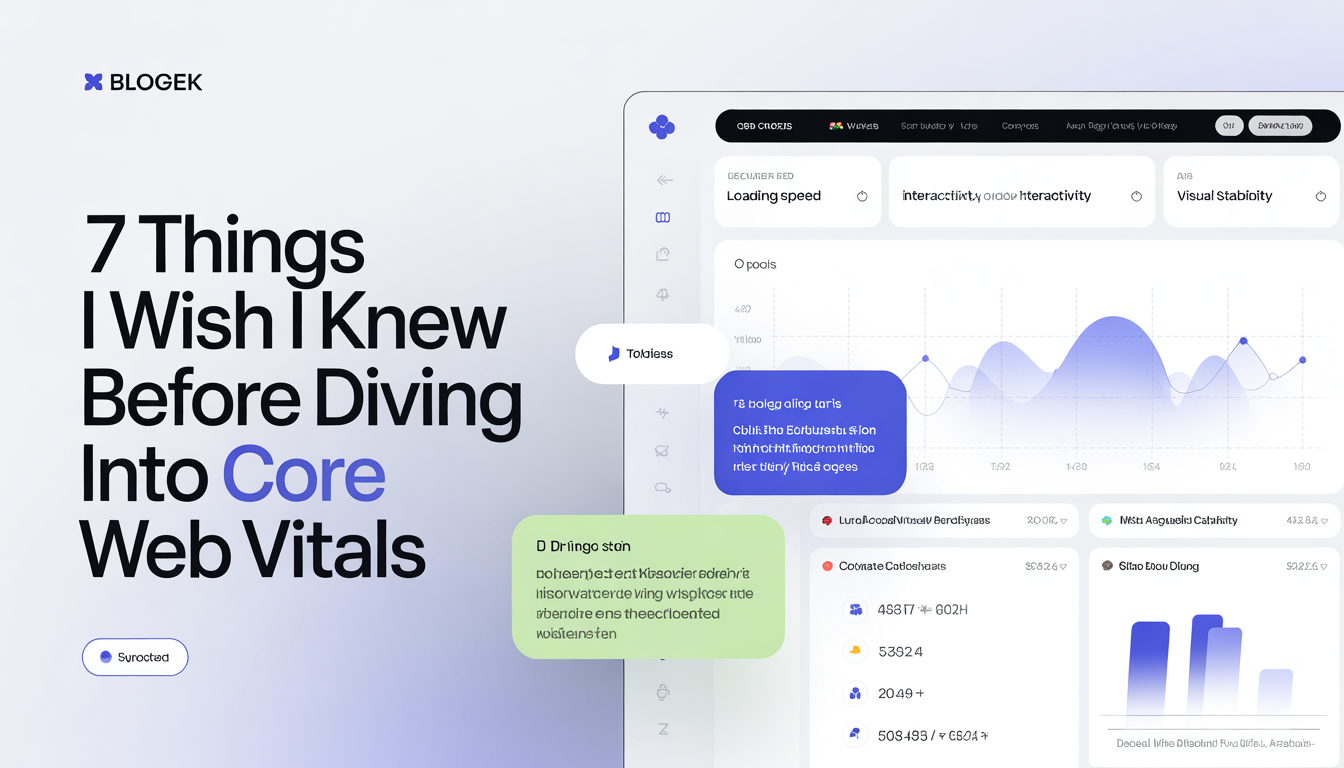
[Table: The 3 Core Metrics You Need to Know]
| Metric | Stands For… | What it Measures | The “Good” Threshold |
| LCP | Largest Contentful Paint | Loading Speed: How long for the main stuff to show up? | Under 2.5 Seconds |
| INP | Interaction with Next Paint | Responsiveness: How fast does the site react to a click? | Under 200 Milliseconds |
| CLS | Cumulative Layout Shift | Visual Stability: Does the content jump around? | Under 0.1 |
The Future: Interaction to Next Paint (INP):
As of March 2024, Google officially replaced FID (First Input Delay) with INP (Interaction to Next Paint). This is a much tougher metric. While FID only measured the first time a user clicked something, INP measures every interaction throughout the entire time a user is on your page.
If your blog has a “Load More” button or a complex menu that takes half a second to open, your INP will fail. This is the new frontier of blogging SEO. It’s no longer enough for the page to start fast; it has to stay fast.
I’ve found that the best way to improve INP is to simplify. Use native browser features instead of heavy JavaScript libraries. If you can do it with simple HTML and CSS, don’t use a script. This is the “secret sauce” of sustainable site structure.
How to Conduct Your Own “CWV Audit”:
If you are feeling overwhelmed, don’t try to fix everything at once. Start with a simple audit that you can hand over to your technical team.
- Check Search Console: Look at the “Core Web Vitals” report. Identify which URLs are “Poor” (Red) and “Need Improvement” (Yellow).
- Run PageSpeed Insights: Focus on the “Field Data” section. Look for the “Opportunities” section at the bottom, this is your to-do list.
- The “Thumb Test”: Open your blog on your phone on a 4G connection. Try to read an article and click three links. If you feel even a moment of frustration, that is a Core Web Vitals problem.
- The Ad Check: If your ads are causing layout shifts, talk to your ad network provider. Most major networks (like Mediavine or AdThrive) have specific “CWV Optimized” settings that you can toggle on.
Bottom Line:
Mastering Core Web Vitals is a journey, not a destination. The web will continue to evolve, and Google will continue to raise the bar for what constitutes a “good” user experience. By focusing on these 7 lessons, you aren’t just “fixing SEO“, you are building a faster, more stable, and more professional home for your content. When your site is technically sound, your “best-written blogs” finally have the stage they need to truly shine.
FAQs:
1. Is Core Web Vitals a “pass/fail” ranking factor?
It’s more of a spectrum. However, crossing the “Good” threshold for all three metrics provides a measurable boost in how Google perceives your site quality.
2. Do I need an expensive developer to fix this?
Not always. Many CWV issues can be fixed by switching to a “fast” theme (like GeneratePress or Astra) and using a well-configured caching plugin (like WP Rocket).
3. Will CWV solve my indexation issues?
Often, yes. If Google’s bots find that your site is extremely slow or “unstable,” they will crawl it less frequently. Improving speed makes it easier for bots to “digest” your site structure.
4. What is the “Origin Summary” in PageSpeed Insights?
It’s the average score for your entire website over the last 28 days. This is the most accurate reflection of how Google actually sees your “Experience” level.
5. Does hosting matter for CWV?
Massively. If your “Time to First Byte” (TTFB) is slow because of a cheap $5/month hosting plan, your LCP will never be in the green. A quality host is the foundation of speed.
6. Can I ignore CWV if I have great content?
You can, but you are leaving money on the table. In competitive niches, the faster site will almost always win the higher ranking and the lower bounce rate.